Collision Coverage Explained: When to Drop It
Collision pays for damage to YOUR car in an accident — but only some accidents. Here's exactly what triggers a collision claim, when you should drop the coverage, and the deductible breakpoint that maximizes savings.
Quick answers
- Does collision cover damage from a pothole?
- Yes, if the pothole damage is sudden and the vehicle is undriveable or wheels/tires/suspension are bent. Routine pothole-induced tire wear is not covered.
- Will my collision claim go on my CLUE report?
- Yes — every claim filed appears on the Comprehensive Loss Underwriting Exchange (CLUE) database for 5-7 years. Future carriers see it during quoting. This is why drivers sometimes pay small claims out of pocket to keep CLUE clean.
- Does collision cover damage from hitting a deer?
- No — hitting a deer is comprehensive (animal strike). Hitting another vehicle while trying to avoid a deer IS collision.
What collision coverage actually pays for
Collision coverage pays for damage to YOUR car when you:
- Hit another vehicle (whether at fault or not, though if not at fault, the other driver's liability is the primary source)
- Hit a stationary object (tree, pole, guardrail, building, wall)
- Roll the vehicle (single-car incident)
- Hit a pothole or curb hard enough to damage suspension/wheels
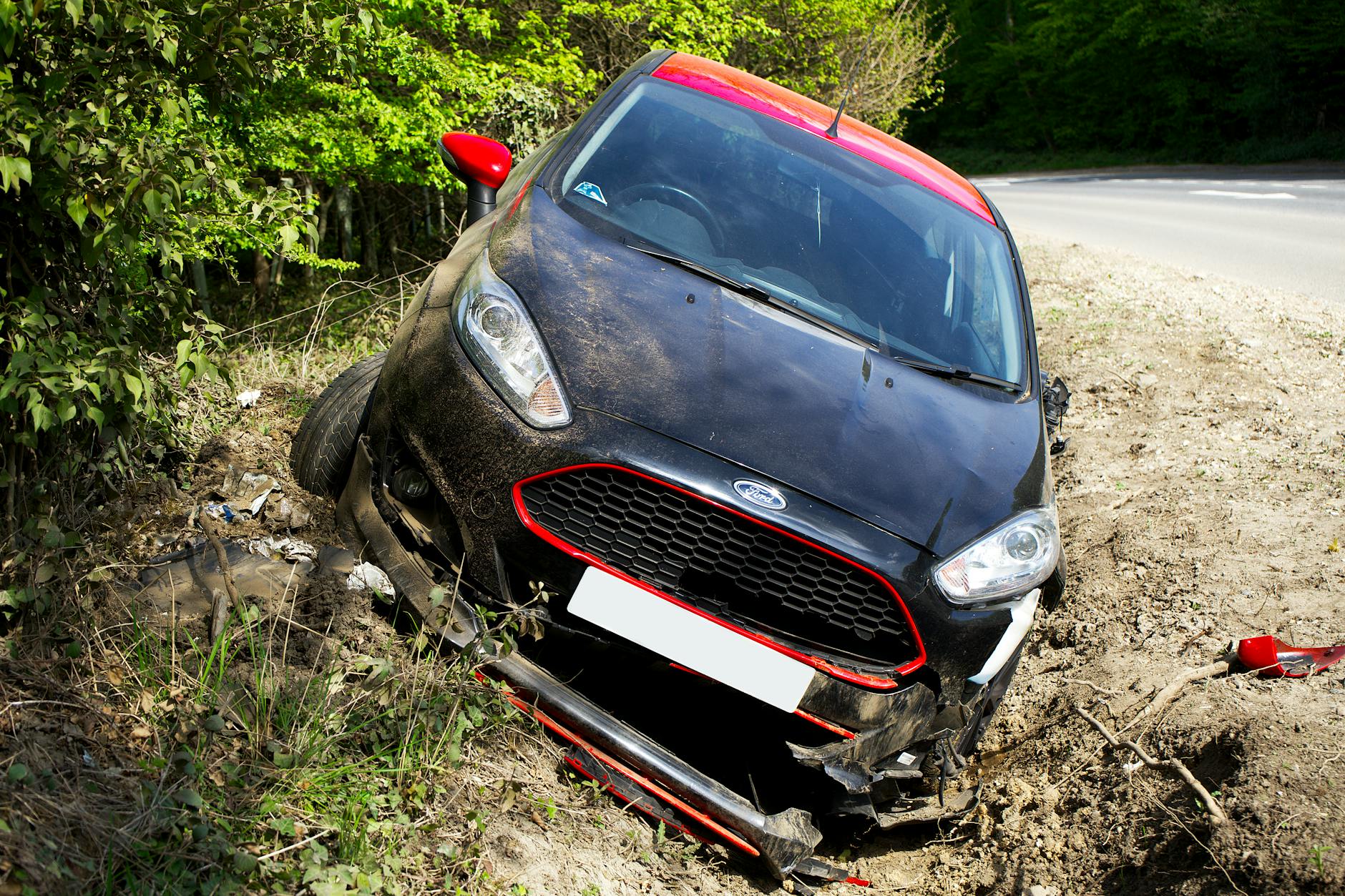
- Have a single-car collision (slide into a ditch, hit a parked car)
It does NOT cover:
- Damage from non-collision events (hail, theft, fire, vandalism — that's comprehensive)
- Mechanical wear and tear
- Other people's vehicles (their damage = your liability coverage)
- Your own medical bills (that's MedPay or PIP)
Collision is what makes "full coverage" actually pay for your own car after a crash.
When you must carry collision
Collision is non-negotiable when:
- You have an auto loan or lease (lender requirement)
- Vehicle ACV > $10,000 and you can't replace it out-of-pocket
- The vehicle is your only transportation (no replacement plan)
- You're a high-mileage driver (>15K/year)
- You drive in a high-claim metro (most major cities)
When you can drop collision
Re-evaluate dropping collision when:
- Vehicle ACV drops below $4,000-$6,000
- Loan is paid off
- You have a substantial emergency fund + a fall-back vehicle
- Premium exceeds 10-15% of vehicle ACV per year
The break-even point: when annual collision premium × 5 years exceeds the maximum possible payout (ACV minus deductible), keeping collision is mathematically a losing trade.
Example: a 12-year-old vehicle worth $4,500 with a $1,000 collision deductible has max payout $3,500. If collision premium is $480/year, 5 years of premium = $2,400 — already 68% of the max possible payout. Drop collision.
The $500 vs $1,000 deductible math
Most carriers offer collision deductibles from $250 to $2,000. The $500-to-$1,000 jump is the highest-leverage decision:
- $500 deductible: covers more in a claim, premium ~$150-$280/year higher
- $1,000 deductible: covers less, premium ~$150-$280/year lower
The math:
- Premium savings from $500 → $1,000 deductible: ~$200/year average
- Difference in claim payout: $500
- Break-even claim frequency: 1 claim every 2.5 years
For drivers with low-claim probability (clean record, low miles, safe ZIP), the $1,000 deductible is mathematically better. For drivers with a history of multiple claims, the $500 deductible is closer to break-even.
How collision claims are valued
When you file a collision claim, the carrier follows this flow:
- Estimate repair cost at a network repair shop (or your shop with carrier approval)
- Compare estimate to ACV (actual cash value of the vehicle)
- If estimate < 70-80% of ACV: pay the estimate minus deductible, repair the vehicle
- If estimate ≥ 70-80% of ACV: declare total loss, pay ACV minus deductible, take possession of the vehicle
The total-loss threshold varies by state (70-80%). After a near-total accident, you'll often be offered the choice to "keep the vehicle" by accepting a smaller payout — useful when the vehicle is still functional despite cosmetic damage.
Common collision claim disputes
Dispute 1 — Diminished value
After repairs, your vehicle's resale value drops 5-15% even when repairs are perfect. About 30% of states allow "diminished value" claims (filed separately from the repair claim) to recover this loss. Worth pursuing on a low-mileage, recent-model vehicle. Carriers rarely volunteer this.
Dispute 2 — Aftermarket parts vs OEM
Most carriers default to aftermarket or used parts to lower repair cost. You can request OEM (factory-original) parts but may pay the price difference. On a leased vehicle, OEM is often contractually required.
Updated Oct 23, 2026
Top insurance carriers for auto insurance shoppers
Comparing 9 audited carriers· Premiums verified Oct 23
Data last reviewed . Source: CarSavr editorial methodology.
Editor's pick · 2-min compare
Insurify
Compare 100+ Insurers in one place

AI-driven personalized quotes
| Carrier | |||
|---|---|---|---|
1  Editor's pick | $136/mo $1,633/yr | Updated 2d ago | ≈2 min · Soft pullAffiliate offer NewStack 2–4 carriers side-by-side to compare premiums, coverage, and ratings at once. |
2  | $113/mo $1,353/yr | Updated 2d ago | ≈2 min · Soft pullAffiliate offer |
- Full coverage
- $136/mo$1,633/yr
- Liability-only
- $53/mo$632/yr
- Full coverage
- $113/mo$1,353/yr
- Liability-only
- $39/mo$467/yr
Premium data: 2024 national-average annual premiums published by Quadrant Information Services from state-DOI rate filings. Sample driver: 35-year-old · clean driving record · $100/$300/$100 full coverage · $1,000 deductible · median ZIP code. Your actual quote will vary based on age, ZIP, driving record, vehicle, credit, and coverage selections. CarSavr may earn a commission when you buy a policy through our links — it never affects how we rank carriers.
Provider logos and trademarks belong to their respective owners and are used for identification purposes only. Providers shown for comparison and educational purposes — display does not imply partnership unless an active affiliate relationship is stated separately.
How rows are ranked: Editor's pick first, then by overall rating. Promoted placements are flagged with a Sponsored badge. Read the full methodology →
Dispute 3 — Total-loss valuation
The ACV the carrier calculates is sometimes 8-15% below actual market value. Push back with: (a) recent comparable-vehicle for-sale listings in your area, (b) your maintenance records, (c) a recent third-party appraisal. Most carriers will adjust 5-12% upward when pressed with documentation.
Collision and "no-fault" states
In no-fault states (FL, HI, KY, MA, MI, MN, NJ, NY, ND, PA, UT), you file your collision claim against YOUR own insurance regardless of who's at fault. The state's no-fault PIP system handles medical separately; collision handles vehicle damage.
In at-fault states (most), if you're not at fault, you'd file against the OTHER driver's property-damage liability. Your collision is a backup if the at-fault driver is uninsured or under-litigated.
What about "broad form collision" or "limited collision"
Some non-standard insurers offer:
- Broad form collision: like regular collision but with a $0 deductible if you're not at fault. Premium uplift: 10-25%.
- Limited collision: only pays when you're not at fault. Cheaper than regular collision (~30-50% less). Pointless for most drivers because the at-fault driver's liability pays in those cases anyway.
For most drivers, regular collision at a $500-$1,000 deductible is the right call.
The "uninsured motorist property damage" alternative
In some states, UMPD (uninsured motorist property damage) coverage pays for damage to your vehicle when an uninsured driver hits you. Cheaper than collision ($30-$80/year) but only triggers when the other driver is uninsured. Some drivers carry UMPD instead of (or in addition to) collision, especially in high-uninsured states like FL/MS/MI.
FAQs
Does collision cover damage from a pothole?
Yes, if the pothole damage is sudden and the vehicle is undriveable or wheels/tires/suspension are bent. Routine pothole-induced tire wear is not covered.
Will my collision claim go on my CLUE report?
Yes — every claim filed appears on the Comprehensive Loss Underwriting Exchange (CLUE) database for 5-7 years. Future carriers see it during quoting. This is why drivers sometimes pay small claims out of pocket to keep CLUE clean.
Does collision cover damage from hitting a deer?
No — hitting a deer is comprehensive (animal strike). Hitting another vehicle while trying to avoid a deer IS collision.
How is collision premium calculated?
Vehicle make/model/year, your driving record, ZIP, annual miles, credit-based insurance score, and how many drivers + their records. Younger drivers and high-performance vehicles see premium uplifts of 1.5-3x baseline.
Can I switch the collision deductible mid-policy?
Yes, most carriers allow mid-term endorsements. Pro-rated premium adjustment applies.
Does collision cover damage to my motorcycle / RV / boat?
No — collision is on the auto policy. Each non-auto vehicle (motorcycle, RV, boat) needs its own collision coverage on its own policy.
The bottom line
Keep collision when your vehicle is worth more than $4,000-$6,000 or you can't replace it out-of-pocket. Drop it when annual premium exceeds 10-15% of your car's value or when five years of premiums would eat up most of the max possible payout (ACV minus deductible).
Choose a $1,000 deductible if you have a clean record and low annual miles—you'll save roughly $200/year and break even as long as you don't file a claim more than once every 2.5 years. If you do file, push back on total-loss valuations with recent comparable listings and maintenance records; carriers typically adjust 5-12% upward when you document market value. In high-uninsured states, consider adding cheap UMPD coverage ($30-$80/year) as a backstop.
Run the math on your current vehicle's ACV, your collision premium, and your claim history right now—you may be over-insured.
Related reading
Auto Insurance
Comprehensive vs Collision Coverage: When to Keep, Drop, or Bundle Each
Collision covers crashes you cause. Comprehensive covers everything else — theft, hail, deer strikes, falling trees. Here's the decision tree by vehicle age, the 10x rule, and when dropping each saves $400-$900/yr.
8 min readSame clusterAuto Insurance
Liability-Only vs. Full Coverage: The 60-Second Decision Tree
Full coverage costs $1,200–$1,800/year more than liability-only. Here's exactly when the math says you're overpaying — and the carrier rule most drivers miss.
9 min readSame clusterAuto Insurance
Uninsured & Underinsured Motorist Coverage: What It Actually Pays and the 13 States That Require It
About 1 in 8 U.S. drivers carries no insurance, and another 30%+ are underinsured. UM/UIM coverage is the only thing standing between you and a $50K hospital bill when one of them hits you. Here's the state-by-state requirement map and the coverage math that beats the minimum.
8 min readSame cluster
Terms in this article
4 financial terms defined
PIP (Personal Injury Protection)
Insurance that covers your own medical bills regardless of who caused the accident.
Auto InsuranceAuto Loan
A secured installment loan used to purchase a vehicle, with the car serving as collateral.
Auto LoansDeductible
The amount you pay out of pocket on a claim before insurance kicks in.
Auto InsuranceNo-Fault State
A state where each driver's insurance pays their own medical bills regardless of fault.
Auto InsuranceSources & methodology
Fact-checked by Abigail MurrayThis guide is based on CarSavr's independent editorial research. Our recommendations follow a documented, conflict-checked review process — how we review auto insurance and our editorial standards.
"Collision Coverage Explained: What It Pays For, When to Drop It (And the $500 vs $1,000 Deductible Math)." CarSavr, June 14, 2026, https://carsavr.com/guides/collision-coverage-explained.See if you're overpaying
Compare auto insurance offers in about 2 minutes.
Free · 2 min · No hard credit pull · No spam
Helpful?
Was this guide useful?
Keep reading

7 Proven Ways To Cut Your Auto Insurance Bill in 2026

Liability-Only Auto Insurance: When State-Minimum Coverage Is Smart and When It's a $40,000 Mistake

Full Coverage Auto Insurance: What 'Full Coverage' Actually Means (And the 3 Coverages It's Missing)

Excluded Driver Forms: How to Legally Remove a High-Risk Household Driver from Your Policy ($1,200-$2,800/yr Savings)

Auto Insurance During a Vehicle Purchase Transition: The 4-Hour Coverage Gap That Costs Drivers $4,800

Comprehensive Auto Coverage Explained: Theft, Hail, Vandalism, Animal Strikes (And the 5 Things It Doesn't Cover)
The CarSavr brief
Cut your car costs.
Smarter car advice, sent when it counts. Free, no spam, unsubscribe anytime.